Alignment
The relative arrangement of body segments in a specified position or task. It describes geometry; it is not a diagnosis.
See the concept in context ↗Research and explanations on movement, health and the decisions we make every day.
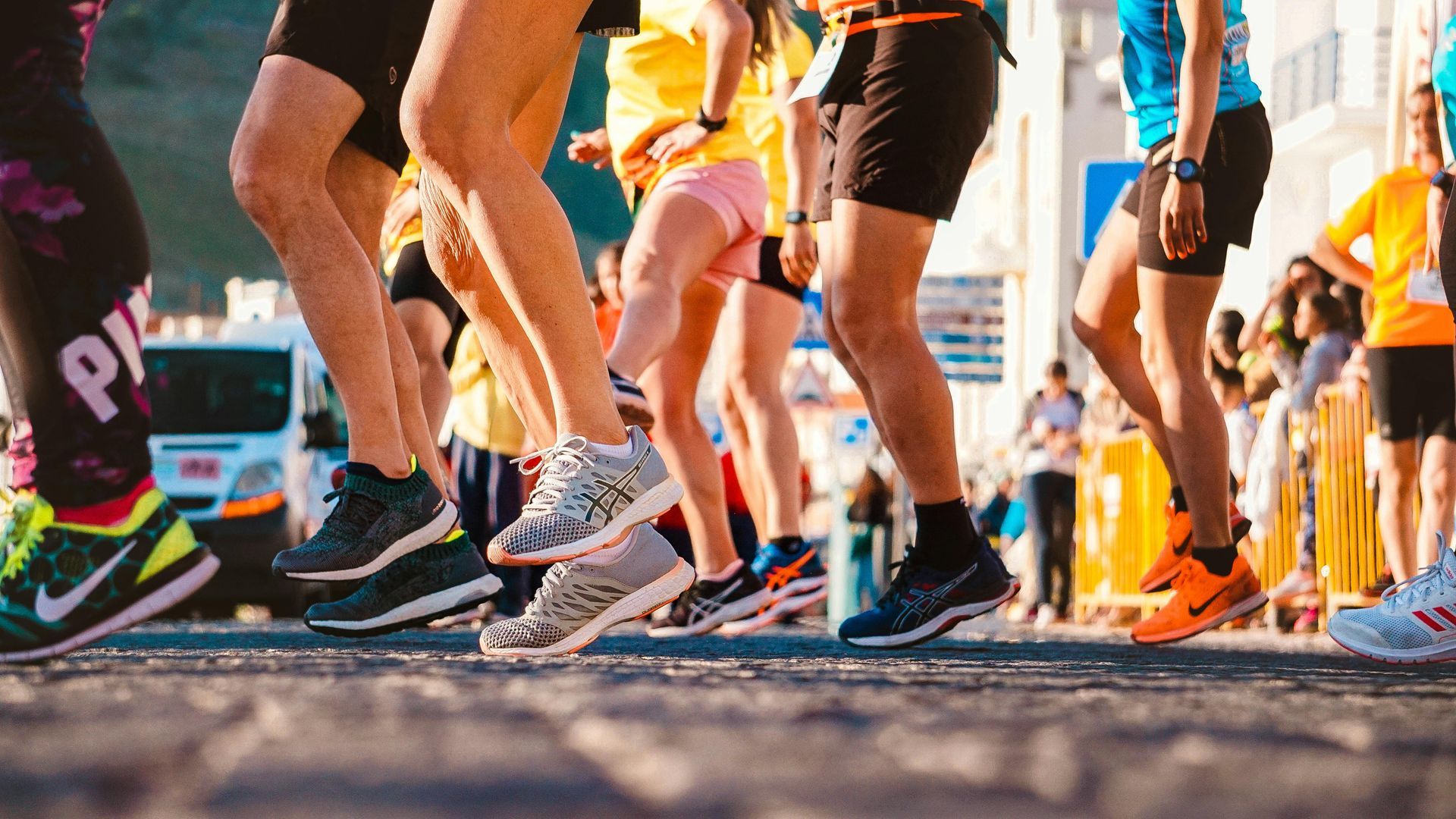
Start with the question / Movement
From the demands of a single day to adaptations over years. Understand what changes with repeated activity, and what the evidence can tell us.
Read the explanationPhotography · RUN4FFWPU / Pexels
Follow a question into movement, training and evidence.
Understand how repeated activity changes what you can do.
02 / TRAININGUnderstand the relationship between strength and aerobic training.
03 / EVIDENCERead the comparison and its limits before accepting the claim.
04 / RECOVERYExplore fatigue, adaptation and the meaning of recovery.

A broader perspective / Health Map
Capacity, wellbeing and the conditions around us. Explore thirty topics across six categories, then follow the question into the research.
Explore the Health MapFollow a question
Start with Why move at all?, or choose a topic. Each article connects a mechanism with practical meaning and makes its evidence limits visible.
8 of 23 articles
Three connected theories, from molecular damage to everyday function. Explore 18 animated figures and evidence from 25 scientific sources.
Explore the science of ageing ↗ Training / Dyb Insight · DanskHvad sker der i kroppen ved aerob træning? 21 adaptationer, 26 forskningskilder og seks interaktive figurer.
Forstå hele systemet ↗ Foundations / Interactive mapThirty topics across six categories, one broader perspective. Explore capacity, wellbeing, context and care.
Explore the Health Map ↗ FoundationsHow repeated demands change physical capacity. Begin with the foundation.
Read the explanation ↗ TrainingBrain, motor units, muscle, leverage and the skill of producing force.
Read the explanation ↗ TrainingLungs, blood, heart, capillaries and mitochondria form one delivery-and-use system.
Read the explanation ↗ TrainingWhat combining strength and endurance means for adaptation, fatigue and priority.
Read the explanation ↗ TrainingContractile machinery, protein turnover and the difference between size and strength.
Read the explanation ↗ Recovery & sleepFuel, fatigue, remodelling and why recovery has more than one clock.
Read the explanation ↗ Recovery & sleepBody-clock timing, sleep pressure and the evidence behind a usable routine.
Read the explanation ↗ TrainingCapacity, sustainable intensity, economy and durability across the distance.
Read the explanation ↗ Body / Illustrated guideCommon patterns, pain research, working positions and the limits of a photograph.
Read the explanation ↗ Body / Illustrated guideExplore Janda’s model, exercise trials and the difference between a pattern and a diagnosis.
Read the explanation ↗ Body / Illustrated guidePelvic tilt, lumbar curves, strength and muscle timing: examine the model and its evidence.
Read the explanation ↗ Life & workHow nociception, protection, experience and the task relate to pain.
Read the explanation ↗ Life & workTask demands, sitting, variation and the organisation of a working day.
Read the explanation ↗ Mind & decisionsSignals, synapses, plasticity, memory and the limits of BDNF measurements.
Read the explanation ↗ Life & workUnderstand reserve as the relationship between what you can do and what a task asks.
Read the explanation ↗ Genes & evidenceAn illustrated hierarchy and a clear guide to study design, certainty and effect size.
Read the explanation ↗ Genes & evidenceTravel from the cell to protein, then distinguish inheritance, association and prediction.
Read the explanation ↗ Life & workClinic tasks, pain and function, exercise trials and practical workplace questions.
Read the explanation ↗ Mind & decisionsSuper Deciders, an interactive iceberg and the tension between using knowledge and exploring alternatives.
Read the explanation ↗ Life & workA short practical note on keeping a movement routine when the original plan no longer fits.
Read the explanation ↗No matches. Try a broader term or clear the topic filter.
A shared vocabulary
Short definitions with a route to the full explanation. Search in English or try familiar Danish terms. The definitions are educational; context and measurement still matter.
12 of 92 matching concepts
The relative arrangement of body segments in a specified position or task. It describes geometry; it is not a diagnosis.
See the concept in context ↗Forward orientation of the pelvis relative to a defined reference. Bone shape and measurement method affect the recorded angle.
See the concept in context ↗Whether a test or classification identifies the condition it is intended to identify. A memorable label is not sufficient evidence.
See the concept in context ↗Recording muscle-related electrical activity. The task, electrodes and analysis affect the result; it is not a direct measure of pain or strength.
See the concept in context ↗Names for outward and inward spinal curves, respectively, in the relevant regions. Their measurement and clinical meaning depend on context.
See the concept in context ↗A position observed at one moment, and the organisation of the body during movement. A photograph captures only part of the picture.
See the concept in context ↗The greatest load completed for one repetition in a defined exercise under specified conditions.
See the concept in context ↗A difference expressed on the outcome's actual scale, such as percentage points. It helps show the practical size of a result.
See the concept in context ↗Contractile proteins whose interactions create tension. Their filaments slide relative to each other rather than simply shrinking.
See the concept in context ↗A change in capacity that develops in response to repeated demands. The response depends on the task and the dose.
See the concept in context ↗A version of a sequence at a particular locus. The relevant versions and their effects depend on the question being studied.
See the concept in context ↗A molecule cells continually regenerate and use to support work, including muscle contraction and ion transport.
See the concept in context ↗Complementary DNA bases across the two strands: A pairs with T, and C with G.
See the concept in context ↗Brain-derived neurotrophic factor, a protein involved in neural processes. A blood measurement does not directly measure brain function.
See the concept in context ↗Agreement between predicted probabilities and observed frequencies across many resolved forecasts. One correct prediction does not establish calibration.
See the concept in context ↗What a person can currently do in a particular task. Strength, endurance, balance and skill describe different aspects.
See the concept in context ↗The smallest blood vessels, bringing blood close to tissue for exchange of oxygen and other substances.
See the concept in context ↗Blood pumped per minute: heart rate multiplied by stroke volume. It is different from oxygen consumption.
See the concept in context ↗Confidence in an estimate across a body of evidence for a particular outcome. It differs from the strength of a recommendation.
See the concept in context ↗A DNA molecule organised with associated proteins. Chromosomes contain genes and other sequence regions.
See the concept in context ↗A roughly 24-hour pattern in biological timing. Light and routine can help align it with the external day.
See the concept in context ↗Whether using a test or prediction improves a meaningful decision or outcome beyond available alternatives.
See the concept in context ↗The changing conditions in which a decision is made, including alertness and competing demands. The iceberg uses this as a conceptual layer, not a score.
See the concept in context ↗A study following a group over time to examine outcomes and exposures. Associations can still reflect confounding or selection.
See the concept in context ↗Combining strength and endurance training. The consequences depend on the outcome, dose, sequencing and recovery context.
See the concept in context ↗An alternative influence related to both the exposure and the outcome that can distort an observed association.
See the concept in context ↗Variation in judgements that cannot be explained by relevant differences. It is distinct from a systematic directional bias.
See the concept in context ↗A nucleic acid carrying sequence information in cells. Its bases are A, T, C and G.
See the concept in context ↗Descriptions of how alleles relate to a specified phenotype in a defined inheritance model. Dominant does not mean stronger, better or more common.
See the concept in context ↗Delayed muscle soreness after an unfamiliar or demanding exposure. Soreness is not a reliable score of adaptation or training quality.
See the concept in context ↗How well physiological qualities are maintained during prolonged exercise. A fresh test does not fully describe late-event capacity.
See the concept in context ↗Regulatory processes associated with gene activity that do not change the underlying DNA sequence. The meaning depends on tissue and context.
See the concept in context ↗Understanding the fit between people, tasks, equipment and organisation. It is broader than finding one supposedly perfect posture.
See the concept in context ↗Planned, structured physical activity used to maintain or develop an ability. It is one part of physical activity.
See the concept in context ↗Using an option that current knowledge suggests is valuable. It can be sensible while leaving alternatives less understood.
See the concept in context ↗Trying or investigating an alternative to learn more. It can create information while sacrificing an immediate familiar return.
See the concept in context ↗Information about what happened after an action. Useful learning also requires asking whether the feedback is timely, comparable and reliable.
See the concept in context ↗Oxygen use equals cardiac output multiplied by the arterial–venous oxygen-content difference, in the appropriate units.
See the concept in context ↗A push or pull. In strength training, the relevant force is expressed within a particular movement and set of conditions.
See the concept in context ↗The room between available capacity and the demand of a task. Both capacity and the environment can change that relationship.
See the concept in context ↗A DNA region contributing to a functional product. Some genes encode proteins; others produce functional RNAs.
See the concept in context ↗The genetic variants a person or organism carries at the loci being described. It is not a complete description of the person.
See the concept in context ↗A stored form of carbohydrate in muscle and liver. Training can use it, and replenishment depends on food, time and the preceding demand.
See the concept in context ↗A genome-wide association study testing statistical relationships between variants and a trait. Association alone does not establish mechanism or useful prediction.
See the concept in context ↗The protein in red blood cells that carries most oxygen in the blood.
See the concept in context ↗A population-level estimate about variation in a trait under particular conditions. It is not the genetic percentage of one person.
See the concept in context ↗A brain structure involved in memory and spatial processing. It works within wider networks rather than storing all memory by itself.
See the concept in context ↗Regulation of internal conditions within workable ranges. Exercise creates demands to which regulatory systems respond.
See the concept in context ↗An increase in muscle size. It can contribute to force capacity without being identical to measured strength.
See the concept in context ↗A possible reduction in a training adaptation when demands are combined. It is outcome-specific and differs from temporary fatigue.
See the concept in context ↗The rate of doing work. When force acts along movement, power is force multiplied by velocity.
See the concept in context ↗Cell division that produces gametes with a reduced chromosome number. Recombination and chromosome assortment contribute to genetic variation.
See the concept in context ↗A statistical combination of study results when appropriate. Pooling does not automatically make biased or dissimilar studies trustworthy.
See the concept in context ↗Cell structures involved in oxidative metabolism and ATP production. Their content and function can adapt to training.
See the concept in context ↗One motor neuron and all the muscle fibres it controls. Recruitment and firing rate help regulate force.
See the concept in context ↗A repeated-choice model in which each option has uncertain rewards. Choices create both an outcome and information about that option.
See the concept in context ↗A nerve cell specialised for receiving, integrating and transmitting signals. Its role depends on the network it belongs to.
See the concept in context ↗Neural processing of potentially harmful stimuli. It differs from the personal experience of pain.
See the concept in context ↗Sleep stages outside REM, ranging from lighter sleep to deeper slow-wave sleep. A night includes changing patterns of both.
See the concept in context ↗Judging an earlier decision primarily by how it turned out. A sound process can produce an unfavourable result under uncertainty.
See the concept in context ↗The proportion of people carrying a particular variant who show the specified phenotype under the conditions studied.
See the concept in context ↗An observable or measurable characteristic, arising through genetic, developmental and environmental influences.
See the concept in context ↗Bodily movement that raises energy expenditure above rest, including transport, work, exercise and everyday tasks.
See the concept in context ↗The nervous system's ability to change with experience and other influences. Change alone does not establish a useful functional outcome.
See the concept in context ↗Influenced by many genetic variants. Effects may be small, and environment and measurement also matter.
See the concept in context ↗Recording a study plan before the relevant results are known. The date and consistency with the final report matter.
See the concept in context ↗Adjusting the challenge as capacity changes. Load, repetitions, duration, range or complexity can change the demand.
See the concept in context ↗The ongoing synthesis and breakdown of proteins. A short-term measurement is different from long-term change in muscle size.
See the concept in context ↗A study allocating participants or clusters by a random process to compare interventions. Random allocation does not remove every source of bias.
See the concept in context ↗How quickly force rises after contraction begins. It is related to rapid actions but differs from mechanical power.
See the concept in context ↗Processes that restore and reorganise after a demand. Fuel replenishment, tissue remodelling and learning have different time courses.
See the concept in context ↗Bringing additional motor units into an effort. This works alongside changes in discharge rate and coordination.
See the concept in context ↗A sleep stage associated with rapid eye movements and distinctive brain activity. It is one recurring part of sleep architecture.
See the concept in context ↗An estimate of how many additional repetitions might be possible before a set cannot be completed. It is an estimate, not a direct measurement.
See the concept in context ↗When the direction of an observed relationship may run from outcome to exposure, rather than the direction initially assumed.
See the concept in context ↗A nucleic acid involved in several cellular roles. Messenger RNA can carry information used to assemble a protein.
See the concept in context ↗The oxygen or energy cost of running at a specified pace. Two people with the same VO₂max can have different economy.
See the concept in context ↗A repeating contractile unit containing overlapping actin and myosin filaments inside a muscle fibre.
See the concept in context ↗Waking time spent sitting, reclining or lying with low energy expenditure. Meeting an exercise target does not eliminate sedentary time.
See the concept in context ↗Increased responsiveness in parts of a sensory system. The term describes a mechanism; it does not, alone, diagnose an individual's pain.
See the concept in context ↗The homeostatic drive for sleep that generally accumulates during wake and dissipates during sleep.
See the concept in context ↗Adaptation reflects the demands practised. Lifting, running and balancing do not create identical changes.
See the concept in context ↗The volume of blood ejected by the heart with each beat. It contributes to cardiac output.
See the concept in context ↗A connection through which one cell influences another. Chemical synapses use neurotransmitters; signalling is not a simple on/off switch.
See the concept in context ↗A structured synthesis using explicit methods to find, assess and combine relevant studies. Its conclusion depends on the included evidence.
See the concept in context ↗What a particular activity asks of a person. Changing setup or the environment can change the demand even when capacity stays the same.
See the concept in context ↗A term used for several intensity-related physiological transitions. The test method and definition matter when comparing thresholds.
See the concept in context ↗The turning effect of force about an axis. It depends on force and the perpendicular moment arm.
See the concept in context ↗The amount of work accumulated. Sets, repetitions and other measures describe different parts of volume and are not interchangeable.
See the concept in context ↗Making an RNA copy from a DNA template. In human protein-coding genes, RNA processing occurs before translation.
See the concept in context ↗Ribosomes read messenger RNA codons to assemble an amino-acid chain. Folding and further processing influence protein function.
See the concept in context ↗The highest rate of oxygen use reached during demanding exercise. It reflects an integrated delivery-and-use system.
See the concept in context ↗No matches. Try a synonym or clear the topic filter.
Try the idea
Educational tools, with no account required.
Read a study in seven steps. Separate what was tested from what is being promised.
Build your reading notes ↗Put a typical week alongside WHO guidance.
Explore your week ↗See how goals, time and equipment change a weekly frame.
Explore the structure ↗Understand the units, methods and what one number leaves out.
Explore the number ↗General education by Zacharias Razvi, final-semester physiotherapy student. Each explanation identifies its sources and limits. Public articles and tools remain freely accessible.
ZACH Insights · Movement, capacity and health
A connected library for understanding what the body does, how training changes it and why the same advice does not fit every person or every week.
Begin with the foundations. Follow the concepts. Use the tools when a number needs context.
New to ZACH Insights? Start here.
Movement is a biological signal. The first article explains adaptation, specificity, physical activity, exercise and the difference between building strength and sustaining aerobic work.
The learning route
Foundation
Demand, adaptation and capacity.
Systems
Strength, cardio and muscle.
Integration
Concurrent training and sleep.
Context
Pain, running and work.
The complete series
Why physical capacity changes, how the body adapts and why movement is not one biological category.
Adaptation · ATP · Capacity · Specificity
Force, neural adaptation, motor units, technique, power and the meaning of a one-repetition maximum.
Force · Motor unit · Torque · Power
VO₂max from lungs to heart, blood, capillaries and mitochondria—and what the number leaves out.
VO₂max · Stroke volume · Fick · Economy
Why the adaptations differ, how concurrent training works and when interference matters.
Concurrent · Interference · Priority · Dose
Hypertrophy · Tension · Volume · Failure
Fatigue · DOMS · Glycogen · Readiness
Circadian · REM · Sleep pressure · Efficiency
Nociception, sensitisation, protection, flare-ups and what pain education can—and cannot—do.
Nociception · Sensitisation · Flare · Graded load
VO₂max, sustainable fraction, economy, durability and the repeated forces of every step.
Threshold · Economy · Durability · Load
Sitting, light movement, exercise, capacity and how the organisation shapes the working day.
Sedentary · MVPA · Ergonomics · Capacity
Free interactive tools
Compare a typical week with WHO guidance without turning it into a health score.
Build an educational weekly frame from goal, available days, experience and equipment.
Understand the unit, test method and the endurance qualities one number cannot capture.
How to read the evidence
Participants are allocated to different interventions. Randomisation can strengthen causal inference, but sample, duration and adherence still matter.
Researchers observe differences or associations. Useful for real-world patterns, but association alone cannot establish cause.
A structured search and appraisal of eligible studies. A meta-analysis may pool results, but diverse or weak studies still limit certainty.
A question after reading?
You do not need to know the right technical term. Tell us what you are trying to understand, what you want your body to be prepared for, or which article needs a clearer explanation.